
In India, supplement labels must follow FSSAI rules. The front of the pack should clearly mention whether the product is a “HEALTH SUPPLEMENT” or “NUTRACEUTICAL” in bold capital letters. The label should also include “NOT FOR MEDICINAL USE”, a complete list of ingredients and nutrients, the amount provided in each serving, recommended daily usage, and important safety warnings.
Launching a health supplement in India involves more than choosing the right ingredients and attractive packaging. FSSAI-compliant supplement labelling is an important requirement that every brand owner and manufacturer must understand before bringing a product to the market. Whether you manufacture supplements in your own facility or have them produced through a third-party manufacturing company, the label must provide accurate and legally required information to consumers.
A well-designed label does more than make your product look professional. It helps build consumer trust, supports regulatory compliance, and reduces the risk of labelling-related issues. From declaring the correct product category and ingredients to mentioning usage instructions, warnings, nutritional information, and mandatory statements, every detail matters.
In this blog, we will explain the key FSSAI supplement labelling guidelines in India in simple language. You will learn what information should appear on supplement packaging and what businesses should check before printing and selling their products.
FSSAI Compliant Supplement Labelling Guidelines
If you manufacture health supplements, nutraceuticals, or similar products in India, you need to pay close attention to the information printed on your product label. A label is not just a way to display your brand name and product details. It also gives consumers important information about what they are buying and how they should use it.
The FSSAI Compliant Supplement Labelling Guidelines help businesses understand what information they need to provide on supplement packaging. These rules apply whether you manufacture the product in your own facility or use a third-party manufacturing company.
Let’s understand the important requirements.
What Is FSSAI Labelling?
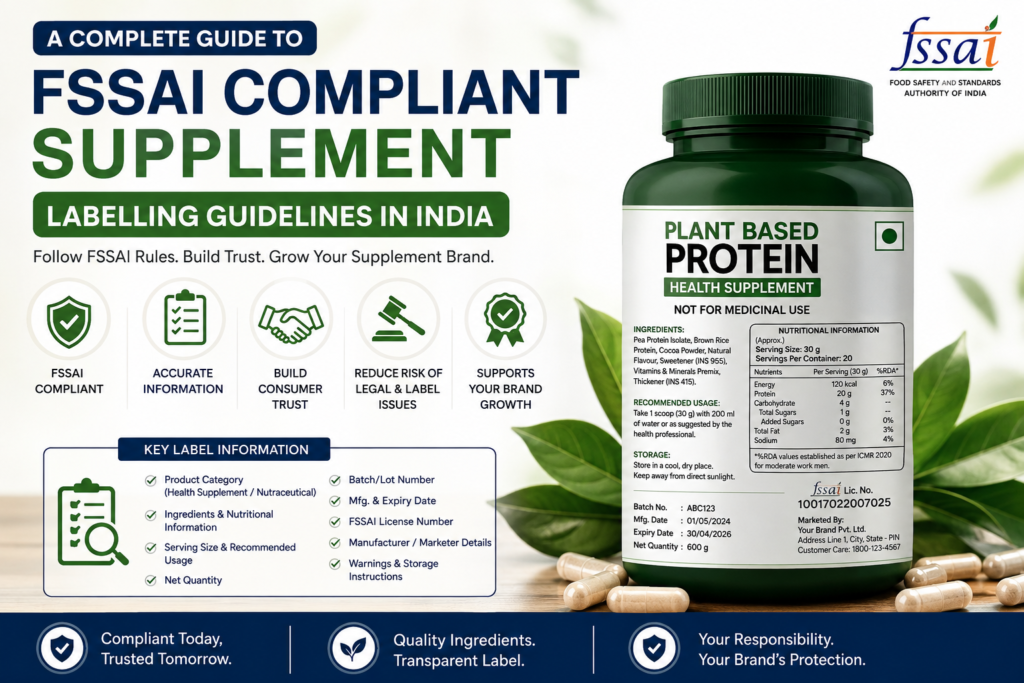
FSSAI labelling refers to the rules that businesses must follow when providing information on food and health supplement packaging. The label should give consumers clear and accurate information about the product. For example, a supplement label may need to mention:
- Product name and category
- Brand name
- List of ingredients
- Nutritional information
- Recommended usage
- Serving size
- Net quantity
- Batch or lot number
- Manufacturing and expiry details
- FSSAI licence information
- Manufacturer or marketer details
- Storage instructions
- Required warnings and precautions
The information should be easy to read and should not mislead consumers.
FSSAI Labelling Requirements 2026 for Supplements
Businesses should check the latest applicable regulations before finalising their packaging because FSSAI requirements can change. The FSSAI labelling requirements 2026 focus on providing consumers with clear, truthful, and complete product information.
For supplement brands, one of the first things to check is whether the product has been correctly classified. Your label should clearly identify the type of product, such as a Health Supplement or Nutraceutical, wherever applicable under the relevant regulations.
The label should also contain the required declarations and information prescribed for the specific product category.
This is especially important for businesses working with third-party manufacturers. Even if another company manufactures your product, you should review the final label carefully before printing.
FSSAI Nutraceutical Labelling: What Should You Check?
FSSAI Nutraceutical Labelling requires businesses to provide consumers with important information about the nutraceutical product.
Before approving a label, check the following:
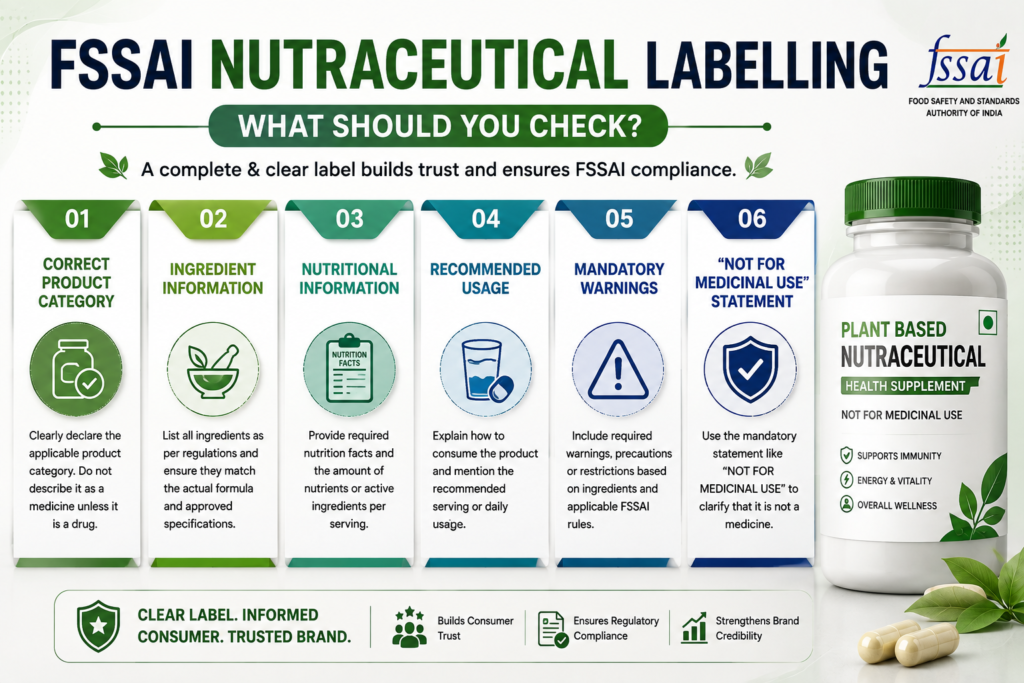
Correct Product Category – Clearly mention the applicable product category on the label. Do not describe a nutraceutical or health supplement as a medicine if it does not fall under the category of a drug.
Ingredient Information – Mention the ingredients used in the product as required by the applicable regulations. The information should match the actual product formulation. If you have hired a third-party manufacturing company, compare the label with the approved product formula and specifications.
Nutritional Information – Where applicable, provide the required nutritional information and the quantity of relevant nutrients or active ingredients. Consumers should be able to understand what the product provides in each serving.
Recommended Usage – Clearly explain how the product should be consumed. Mention the recommended serving or daily usage as required. Avoid making instructions that could encourage consumers to take the product in an unsafe or excessive amount.
Mandatory Warnings – Some supplements require specific warnings, precautions, or restrictions based on their ingredients and category. Do not treat these statements as optional. Check the applicable FSSAI rules for your particular formulation before finalising the packaging.
“Not for Medicinal Use” Statement – Health supplements and nutraceuticals are not medicines. Where applicable, the label must carry the required statement such as “NOT FOR MEDICINAL USE.” This helps consumers understand that the product should not be considered a medicine for treating or curing diseases.
FSSAI Nutraceutical Labelling 2026: Why Businesses Should Be Careful
The rules for nutraceutical products can be detailed because different ingredients and product categories may have different requirements.
For this reason, businesses should not simply copy the label of another supplement. A label that works for one product may not be suitable for another.
For FSSAI nutraceutical labelling 2026, businesses should review the current requirements applicable to their product, ingredients, claims, serving size, and category before sending the packaging for printing.
This becomes even more important when a company uses a third-party manufacturer. The manufacturer may help with production and documentation, but the brand owner should still make sure the final label contains the correct information.
What About Health Claims on Supplement Labels?
This is one area where businesses need to be particularly careful.
A supplement label should not make misleading claims or present the product as a treatment or cure for a disease. Claims should be appropriate for the product and supported as required by the applicable regulations.
For example, avoid making strong medical claims simply because a particular ingredient is associated with a health benefit.
Before printing statements such as:
“Treats diabetes”
“Cures anxiety”
“Prevents heart disease”
“Guaranteed weight loss”
businesses should check whether such claims are permitted for their product.
The wording used on your packaging, website, advertisements, and promotional material should also remain consistent with the applicable requirements.
Responsibilities When Using a Third-Party Manufacturer
Many supplement brands choose third-party manufacturing because it allows them to launch products without setting up their own manufacturing facility. However, outsourcing production does not mean you should ignore the label. As a brand owner, you should:
- Share the correct product details with the manufacturer.
- Confirm the product category.
- Check the ingredient list and quantities.
- Review the nutritional information.
- Verify mandatory declarations and warnings.
- Check manufacturer and marketer details.
- Review the FSSAI licence information.
- Check batch, date, and other required details.
- Review all health or nutrition claims.
- Approve the final artwork before printing.
Common FSSAI Labelling Mistakes Businesses Should Avoid
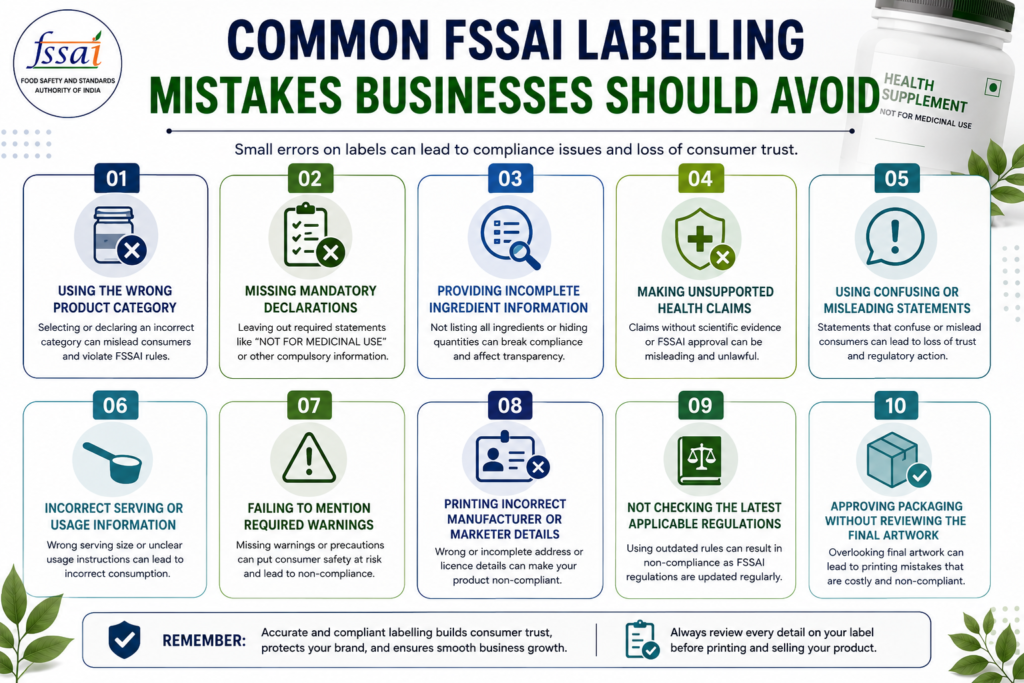
Businesses often focus heavily on the product formulation and packaging design but overlook small labelling details. Some common mistakes include:
- Using the wrong product category
- Missing mandatory declarations
- Providing incomplete ingredient information
- Making unsupported health claims
- Using confusing or misleading statements
- Incorrect serving or usage information
- Failing to mention required warnings
- Printing incorrect manufacturer or marketer details
- Not checking the latest applicable regulations
- Approving packaging without reviewing the final artwork
These mistakes can create compliance problems and may also reduce consumer confidence in your brand.
Final Checklist Before Printing Supplement Labels
Before sending your supplement packaging for printing, review the entire label carefully. Ask yourself:
- Is the product category correct?
- Are all required ingredients listed?
- Is the nutritional information accurate?
- Is the serving size clearly mentioned?
- Are the usage instructions easy to understand?
- Are all required warnings included?
- Is the required “NOT FOR MEDICINAL USE” statement present, where applicable?
- Are manufacturer and marketer details correct?
- Is the FSSAI licence information accurate?
- Are the batch number, dates, and net quantity correct?
- Are the claims on the label permitted and properly supported?
- Does the final artwork match the approved product information?
Final Words
Following the FSSAI Compliant Supplement Labelling Guidelines is an important part of launching and selling supplements in India. A compliant label gives consumers the information they need and helps businesses avoid unnecessary regulatory and packaging problems.
Whether you manufacture products yourself or work with a third-party manufacturing company, take time to review every part of your label before printing. Keep your product category, ingredients, nutritional details, usage instructions, warnings, and claims accurate and easy to understand.
Most importantly, do not rely on an old label or another brand’s packaging as your guide. Always check the latest FSSAI labelling requirements 2026 applicable to your specific product and formulation.