If you are planning to start your own supplement brand, then understanding Nutraceutical OEM vs ODM vs Private Label manufacturing is an important step. These three manufacturing models allow you to sell nutraceutical products under your own brand name, but they differ in product development, customisation, investment, and manufacturing responsibilities. So, which model should you choose for your nutraceutical business? Should you develop your own product, choose a ready-made formula, or work with a manufacturer to create a customised supplement?
To make it easier for you, in this guide, we will explain Nutraceutical OEM vs ODM vs Private Label, their key differences, benefits, costs, and how to choose the right manufacturing model based on your business goals and budget.
Quick Guide to OEM, ODM, and Private Label Manufacturing
Nutraceutical OEM, ODM, and Private Label Manufacturing are three different ways to start your own nutraceutical supplement brand in India.
- OEM Manufacturing: Best for businesses that already have their own product formulations and want more control over product specifications.
- ODM Manufacturing: It is ideal for brands that need help with product formulation, development, and technical support.
- Private Label Manufacturing: This model is best for startups and entrepreneurs who want to sell supplements using ready-made formulations with their own brand name and packaging.
Choosing the right nutraceutical manufacturing model depends on your budget, product requirements, customisation needs, and business goals. SevenQ Nutrition offers nutraceutical manufacturing solutions to help businesses develop and launch their own supplement brands.
Why Is Nutraceutical Manufacturing a Growing Business Opportunity?
The demand for nutraceutical products is increasing as more people focus on nutrition, fitness, immunity, and preventive healthcare. Products such as multivitamins, herbal supplements, probiotics, protein powders, and women’s health supplements are becoming popular among consumers.
According to the Ministry of Food Processing Industries (MoFPI), India’s nutraceutical market was valued at approximately USD 30.37 billion in 2024, and it is expected to grow at a CAGR of 13.6% from 2025 to 2030. This growth is creating new opportunities for startups, healthcare companies, and entrepreneurs who are looking to launch their own supplement brands.
However, setting up a manufacturing unit requires significant investment in machinery, infrastructure, manpower, and quality control. Partnering with a third-party nutraceutical manufacturer allows you to launch your products without setting up your own factory, while focusing on branding, marketing, and sales.
Understanding Nutraceutical OEM, ODM, and Private Label Manufacturing Models
Before choosing a manufacturing model, it is important to understand how OEM, ODM, and private label manufacturing work. All three allow you to sell nutraceutical products under your own brand name, but they are different in product development, customisation, and the level of support provided by the manufacturer. Let’s understand each manufacturing model in detail.
What Is Nutraceutical OEM Manufacturing?
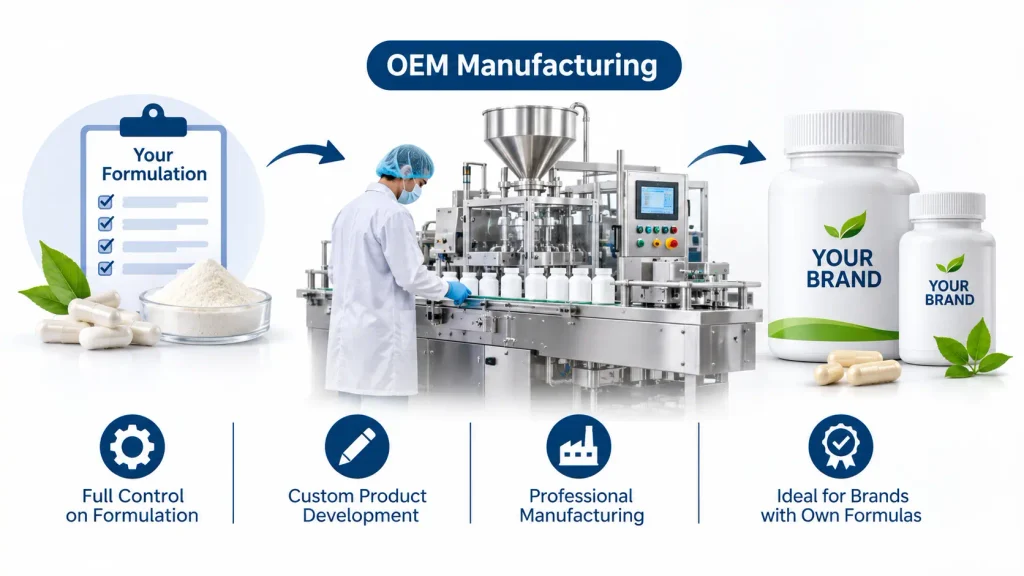
OEM stands for Original Equipment Manufacturing. In this model, you provide the product formulation, specifications, or design, and the manufacturer produces the nutraceutical product according to your requirements.
For example, if you want to launch a protein supplement with a specific ingredient combination, you can share your formulation and product requirements with the manufacturer. They will handle the production as per the agreed specifications.
Best for: Established supplement brands and businesses that have their own formulations and want control over product development.
Key Benefits of OEM Manufacturing:
- Greater control over product formulation and specifications.
- Products can be developed according to your brand requirements.
- Access to professional manufacturing facilities.
- Suitable for businesses with their own product ideas and formulations
What Is Nutraceutical ODM Manufacturing?
\
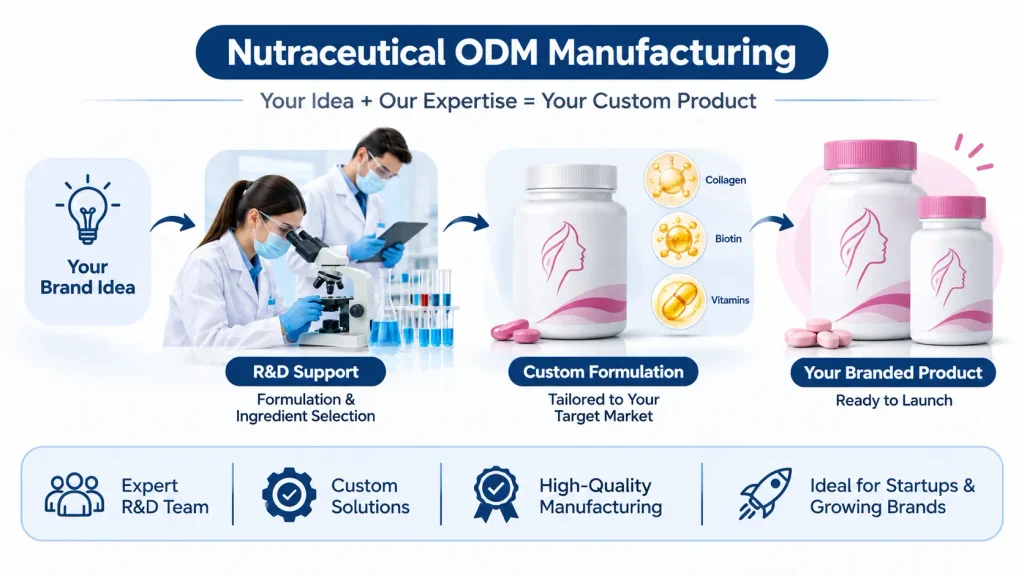
ODM stands for Original Design Manufacturing. In this model, the manufacturer helps to develop the product, including its formulation, ingredient selection, and technical requirements. In this manufacturing model, you do not need to develop everything on your own. Instead of that, you can work with the manufacturer’s R&D team to create a product that matches your brand and target market.
For example, if you want to launch a beauty supplement containing collagen, biotin, and vitamins, an ODM manufacturer can help to develop the formulation and produce the finished product.
Best for: Startups and growing supplement brands that want customised products but need expert support with formulation and development.
Key benefits of ODM manufacturing:
- Access to formulation and R&D support.
- Help with ingredient selection and product development.
- Less need for an in-house technical team.
- Options for customised supplement products.
What Is Private Label Nutraceutical Manufacturing?
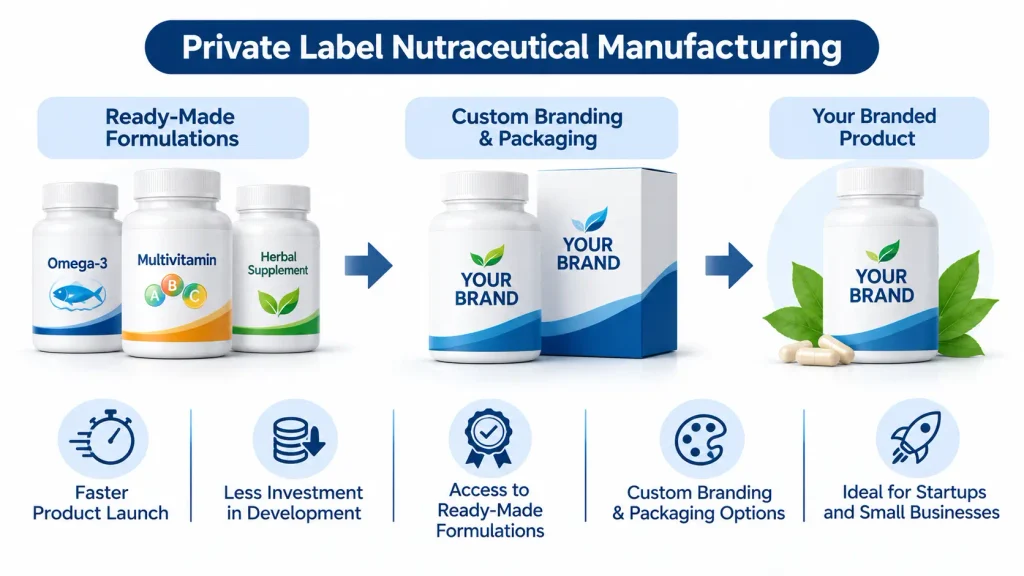
Private label nutraceutical manufacturing allows you to sell existing or ready-made nutraceutical formulations under your own brand name. The manufacturer handles production, while you can choose the products and customize their branding and packaging.
For example, you can select an existing multivitamin, omega-3, or herbal supplement formulation and sell it under your own brand name with customized labels and packaging.
Best for: New entrepreneurs, D2C brands, distributors, and businesses who are looking to enter the nutraceutical market with ready-made products.
Key benefits of private label manufacturing:
- Faster product launch.
- Less investment in product development.
- Access to ready-made formulations.
- Custom branding and packaging options.
- Suitable for startups and small businesses.
Nutraceutical OEM vs ODM vs Private Label: Key Differences
All three manufacturing models allow you to sell supplements under your own brand name. However, they differ in how products are developed, how much you can customise them, and what support the manufacturer provides. The table below highlights the main differences between OEM, ODM, and private label manufacturing.
| Comparison Factor | OEM | ODM | Private Label |
| Full Form | Original Equipment Manufacturing | Original Design Manufacturing | Private Label |
| Formulation | Based on your requirements | Developed by the manufacturer | Ready-made formulation |
| Customisation | High | Medium to high | Limited to moderate |
| R&D Support | Depends on the manufacturer | Usually higher | Usually limited |
| Initial Investment | Generally higher | Moderate to high | Generally lower |
| Development Time | Usually longer | Moderate | Usually shorter |
| Product Uniqueness | High | Moderate to high | Usually limited |
| Best For | Established brands | Growing businesses | Startups |
OEM vs ODM vs Private Label: Which Model Is Right for Your Brand?
Choosing between OEM, ODM, and private label manufacturing depends on your business goals, budget, and product requirements. Each model offers different benefits, so the right choice depends on how much control and support you need. Here is a simple way to choose:
Choose OEM Manufacturing If:
- You already have your own product formulation or specifications.
- You want more control over product ingredients and composition.
- You want to develop unique supplements for your brand.
Choose ODM Manufacturing If:
- You need help with product formulation and development.
- You want customised supplements with professional R&D support.
- You want to develop products for a specific customer group.
Choose Private Label Manufacturing If:
- You are new to the nutraceutical business.
- You want to launch products using ready-made formulations.
- You want to focus more on branding, marketing, and sales.
Moreover, if you are just starting, then private label manufacturing can be a simpler way to enter the nutraceutical market. As your business grows and you understand customer demand, you can move towards ODM or OEM manufacturing to offer more customised products.
Why Choose SevenQ Nutrition for Nutraceutical Manufacturing?
If you want to start your own supplement brand, SevenQ Nutrition offers third-party, private label, and contract nutraceutical manufacturing services for startups and established businesses. Based in Ahmedabad, Gujarat, our company offers both ready-made and customised formulations across different product categories. Our manufacturing capabilities include gummies, tablets, capsules, softgels, effervescent tablets, powders, syrups, shots, and sachets.

Being a trusted nutraceutical manufacturer in India, SevenQ Nutrition also supports businesses with formulation development, ingredient selection, packaging, branding, and regulatory documentation. Along with this, we follow quality certifications and standards such as WHO-GMP, ISO 22000, HACCP, and FSSAI.
Whether you are a startup looking for ready-made supplements or an established brand planning to launch customised products, SevenQ Nutrition can help you to choose a suitable nutraceutical manufacturing partner solution for your business.
Conclusion
Choosing between nutraceutical OEM vs ODM vs private label manufacturing depends on your budget, product requirements, and business goals. OEM manufacturing gives you more control over product specifications, ODM manufacturing offers support with product development, while private label manufacturing helps you launch your supplement brand using ready-made formulations.
In the above blog, we have mentioned a complete we have explained the key differences between these three manufacturing models, their benefits, and how to choose the right option for your business. We hope this guide helps you make a better decision and take the first step towards building your own nutraceutical brand with SevenQ Nutrition.
FAQs (Frequently Asked Questions)
Which manufacturing model is best for a nutraceutical startup?
Private label manufacturing is often a practical starting point because it allows startups to launch products without investing in complete formulation development.
How do I choose a reliable nutraceutical manufacturer in India?
Check the manufacturer’s certifications, quality control procedures, product range, R&D capabilities, MOQ, testing documentation, and delivery track record.
How long does it take to manufacture nutraceutical products?
Manufacturing timelines depend on the formulation, raw material availability, product testing, packaging, order quantity, and regulatory requirements. Private label products may have shorter development timelines than customised products.
Do nutraceutical manufacturers provide packaging and labelling?
Yes. Many nutraceutical manufacturers offer packaging and labelling support, including bottles, jars, sachets, pouches, and blister packaging. Options vary by manufacturer.
Is third-party nutraceutical manufacturing suitable for D2C brands?
Yes. It allows D2C brands to launch supplements without building their own production facilities. They can focus on product positioning, online marketing, customer acquisition, and distribution.